

Okinawa Goju Ryu Karate-Do Kyokai

OGKK was founded to continue the legacy of Goju-Ryu karate, a style developed by Chojun Miyagi in the early 20th century. Chojun Miyagi, a prominent martial artist from Okinawa, synthesized the hard (Go) and soft (Ju) elements of martial arts into a cohesive and effective system. This blend of techniques emphasizes both powerful strikes and fluid movements, embodying the philosophy of balance and adaptability.
The organization was officially established to provide a structured platform for the instruction and dissemination of Goju-Ryu karate, ensuring that the principles and techniques remain true to their original form. OGKK was created with the mission of preserving the integrity of Goju-Ryu karate while adapting to modern training methodologies.
History
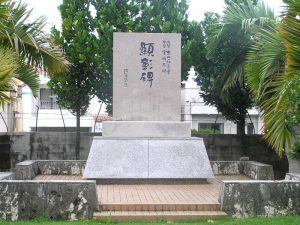
This monument is dedicated to two renowned masters, Higaonna Kanryō (1853-1917), an expert of Nahate and Miyagi Chōjun (1888-1953), founder of Gōjū-ryū. It was built in 1987 for the 100 years commemoration of the birth of Miyagi Chōjun.
On the front side of the monument is written from the right: Ancient sage Higaonna Kanryō – Fist saint Miyagi Chōjun – Praising Monument – Calligraphy by Chin Honbu.
In the back of the monument itself are inscribed biographies and dying instructions of the two masters.

Kanryo Higaonna was born on March 10, 1853 in the district of Nishimura in the city of Naha, Okinawa. He was the son of Kanryo and Makomado. His father, Kanryo, was a merchant dedicated to trade with food and clothes through the Ryukyu Islands. Since his second and third brothers died at an early age, and his first brother was weak and sick, Kanryo Higonna Sensei started to work with his father at the age of ten. At the age of 14 he was honored with the traditional ceremony of “katagashira” to celebrate his manhood.
Unfortunately not too long after; in 1867, his father died suddenly as the result of a fight. This shocked the young Higaonna so much that the only thought that he was able to keep was his desire for revenge for the death of his father. It is at this point of his life when he decided to travel to China to learn the deadly Martial Arts to avenge his father’s death. However, in those days, traveling to China was restricted only to merchants, students or government officials, and permission to travel was only granted by the King of Okinawa, and the only port of departure was the port of Naha.
Kanryo Higaonna, with the help of the official Udon Yoshimura, was able to get the permit to travel to Fuchow, China, as a student; departing from the port of Naha in the year 1868, at the age of 15. The desire for revenge was traveling with him, too.
At his arrival to the city of Fuchow, Kanryo Higaonna was accepted in the Ryukyu Kan or lodge where all the students from Okinawa were living. Once in Fuchow, Kanryo Higaonna was introduced to the well renowned martial arts instructor Ryu Ryu Ko. Ryu Ryu Ko Sensei was tall and strong, and even at his old age his speed and power was admirable. Ryu Ryu Ko Sensei’s family was part of the Novel Court of China before they lost their status as a result of the politic turmoil in the country. Ryu Ryu Ko Sensei worked in bamboo, his shop on the first floor of the building and his house on the second floor. He taught martial arts at his house only to a small group of selected students.
In the beginning, Kanryo Higaonna only performed duties in the yard of Ryu Ryu Ko Sensei and sometimes in his shop before he decided to start to teach him the martial arts. At first Kanryo Higaonna was instructed only in Sanchin kata. His motivation and dedication soon started to show up in the progress of his skills, and he became “uchi deshi” (live-in student). He moved out from the Ryukyu Kan and started to live and work at Ryu Ryu Ko Sensei’s bamboo shop. He was introduced to the different traditional equipment such as chiishi, ishi sashi, nigiri game, tan and muning (variation of makiwara). The training was very severe.
The fame of Ryu Ryu Ko Sensei was wide. He learned the martial arts in the southern Shaolin temple in the mountains of the Fujian Province. His teacher was a Court Official from the Dynasty. Ryu Ryu Ko Sensei also instructed Kanryo Higaonna in the use of weapons such the Daito (long sword), Shuto (small sword), Sai and Bo. He also taught him herbal medicine. In a few years, Kanryo Higaonna became Ryu Ryu Ko Sensei’s top student. Kanryo Higaonna practiced 14 years in China until Ryu Ryu Ko Sensei told him that it was time for him to go back home, and in 1881 Kanryo Higaonna returned to Okinawa.
He returned to difficult political times in Okinawa, and he established himself in the district of Nishimura in the city of Naha. He started as his father did in the past as a merchant traveling with his boat in between the islands of the Ryukyu chain.
He then started to teach a select group of students at his house. His instruction was very severe. In a short time he obtained in Okinawa the same good reputation that he developed in Fuchow. It wasn’t too long before the King of Okinawa invited Kanryo Higaonna to teach him the martial arts.
In 1905 he was invited to teach his Naha-Te or Te from Naha (name called then) in the Naha Commercial School. The principal wanted to teach the students the spiritual and moral aspects of the martial arts. This was an important step in the Naha-Te, not only for the recognition of the benefits of the practice but also because until then, Te was taught as a martial art, with the skill to kill.
After his research, Kanryo Higaonna, decided to make an important change in the Sanchin kata. Until then, Sanchin kata was practiced with open hands, so he started to teach it with closed hands and slower breathing with the purpose of promoting the health benefits, rather than promoting lethal techniques at the school. Kanryo Higaonna introduced the closed fist to emphasize the physical strength more than the ability to kill. Tradition also played an important roll for this change because he noticed that a lot of young Okinawans, without acknowledgement of martial arts, naturally stood with closed fists when they were going to fight. He continued to teach the original way that he learned in China to his few students at his dojo.
After 1905, karate became a little bit more accessible to the general population because until then Te was practiced just by a selected group of people. Kanryo Higaonna Sensei passed away in October, 1915 at the age of 62.
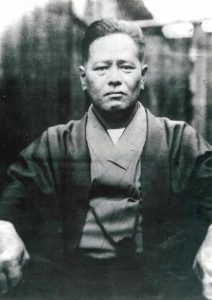
After seeing the dedication of Chojun Miyagi, Aragaki Ryuko decided to introduce him to Kanryo Higaonna. In 1902, at the age of 14, Chojun Miyagi Sensei started to practice with Kanryo Higaonna Sensei. At the age of 20, Chojun Miyagi became Kanryo Higaonna’s top student and around that time is also when he got married.
At the age of 22, he traveled to the main island of Kyushu for his military service. After 2 years of service he returned to Okinawa. For the next 3 years Kanryo Higaonna taught him privately until Kanryo Higaonna died in 1915.
With his death, Chojun Miyagi decided to follow the steps of his Sensei and travel to Fuchow, China, where he learned the martial arts. In his first trip in 1915, he went to Fuchow and trained for two months with a student of Ryu Ryu Ko Sensei. The old man was very impressed with the skill of Chojun Miyagi. Chojun Miyagi went to visit the grave of Ryu Ryu Ko Sensei as well as to the temple were he trained. It was easy to see the footmarks on the patio from the training.
Between 1920 and 1930 Chojun Miyagi traveled to China for the second time. This was not a productive trip because the relations between China and Japan were not good in those days.
In his third trip to China, in 1936, he was able to contact the Shanghai Martial Arts Federation. This was instrumental in helping him do his research in the martial arts.
In the early 20’s Chojun Miyagi developed the characteristic Goju Ryu warming up exercises or Yunbi Undo with the help of a friend of his, who was a doctor. This series of exercises were based not only on martial arts fundaments but also on medical research. It is also around this time that Chojun Miyagi also developed the kata Tensho, and began to teach in high school in Okinawa.
In 1925, Chojun Miyagi, Hanashiro Chomo, Mabuni Kenwa and Motobu Choki formed the Karate Kenkyu Kai or Karate Research Club at Naha, with the idea of preserving and practicing karate with members of other lines of Te. Unfortunately the club disbanded in 1929.
In 1930 Chojun Miyagi sent his top student, Jihan Shinzato, to perform a demonstration of Te at the Meiji Shrine in Tokyo. Upon his return to Okinawa, Shinzato asked his Sensei about the name of the style of karate that they practiced because a Kobudo Sensei present at the demonstration inquired the same of Shinzato. Shinzato Sensei could not answer because until then they only referred to karate as Te (hand), To (China) or Bu (martial art). Chojun Miyagi decided for the first time to call his style Goju Ryu. The meaning was extracted from the Bubishi or book of the poems where there are references to different subjects including the martial arts. The name Goju Ryu identifies the style as the style of the hardness and softness. In this way Goju Ryu became the first style of karate named.
It was in 1933 when Goju Ryu was officially recorded and recognized in the Butoku Kai (the institution that groups all the martial arts in Japan) in Kyoto. The official name was recorded as Goju Ryu Karate-Do, where the meaning of the character (kanji) Karate was To (China) in recognition of origin of this martial art, and not the meaning “empty” as is in the present.
In 1934, Chojun Miyagi was appointed as the representative of the Butoku Kai in Okinawa. Also in this year, Chojun Miyagi was invited to travel to Hawaii to teach karate to the Okinawans living on the island. He remained in Hawaii for 6 months.
In 1937 Chojun Miyagi was honored. He received the title Kyoshigo from the Butoku Kai. This was the first time in history that somebody in karate received this honor.
During World War II, Chojun Miyagi lost his top student Jihan Shinzato as well as two of his daughters. Chojun Miyagi Sensei passed away on October 8, 1953 at the age of 65.

Miyazato was also a great judoka: he became champion of Okinawa 1950 or 1951. Miyazato also became a skilled judo master in the local police judo club and president of the Okinawa Judo Federation.
Miyazato began practicing Karate with his father (student of Kanryo Higaonna) and then became a student of Miyagi around the age of 13. Since that time, Miyazato, except for a short period during the war, trained continuously with Miyagi until his death. He also assisted Miyagi in teaching in the Okinawa Police School and was also the only one to have learned the entire teaching system and all the Kata. Miyazato was also a judo instructor: a discipline that Miyagi himself invited him to cultivate as it was complementary to Goju Ryu Karate.
Miyazato joined the Ryukyu Police Department on Miyagi’s recommendation in 1946. He served as physical education instructor at the police academy, and assisted Miyagi (then an instructor at the academy), teaching karate and judo there. Upon Miyagi’s death in 1953, Miyazato inherited his teacher’s training equipment; he also took up the position of teaching at the ‘Garden dojo,’ which had been Miyagi’s dojo.
After Miyagi’s death (1953), the family communicated that the founder of the style wanted Eiichi Miyazato to succeed him. The Goju Ryu committee (formed by its major students) at a meeting in February 1954 voted almost unanimously Eiichi Miyazato as the official successor to Chojun Miyagi. In 1956, Miyazato opened his own dojo, the Jundokan, in Asato, Naha. The building had three levels, with Miyazato’s dwelling located on the top level. In 1972, he retired from the police force and devoted the rest of his life to teaching karate. Through the early 1970s, he served as Vice-President of the Okinawan Judo Federation and President of the Okinawa Prefecture Karate-do Federation.
On March 20, 1988, the Okinawa Goju-ryu Karate-do Kyokai awarded him the rank of 10th dan in karate. Apart from his karate rank, Miyazato held the rank of 7th dan in judo from the Kodokan, and was President of the Okinawa Judo Federation.
Miyazato received several awards for his contribution to the martial arts. In 1984, Miyazato received an official commendation from the Kodokan. In 1994, he was awarded a Commendation for Distinguished Service from the Nihon Budo Kyogikai and received an official commendation from the Okinawa Judo Federation. In 1998, he received an official commendation from the Japanese Ministry of Education.
Following a period of poor health, Miyazato died on December 11, 1999, in Naha Hospital. On his death, the Kodokan awarded him the rank of 8th dan in judo. Miyazato’s students included Teruo Chinen, Morio Higaonna, Masaji Taira, Ronald Michio Yamanaka and Mike Clarke
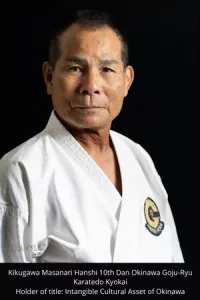
Sensei Masanari Kikugawa
Sensei Masanari Kikugawa, 10th Dan and Vice President of the Okinawa Goju-ryu Karate-do Association, is renowned for his powerful kata performances and global contributions to Gōjū-ryū. A multiple-time national and international kata champion — including at the Japanese Kata Championships and Asian Championship — he is especially known for his mastery of Kururunfa.
Kata
In Okinawan Goju-ryu, kata are not merely forms, but living lessons — each one revealing a deeper understanding of balance, breath, and the spirit of martial practice.
Kihon Kata

Translated to “Three Battles 1”; the foundation of Goju-ryu.
Sanchin forges the body and disciplines the breath. Through tension and stillness, the practitioner learns correct posture, rooted stance, and focused intent. Body, breath, and mind are unified, creating an unshakable foundation for all further training.
Translated to “Three Battles 2”; the foundation of Goju-ryu.
Sanchin forges the body and disciplines the breath. Through tension and stillness, the practitioner learns correct posture, rooted stance, and focused intent. Body, breath, and mind are unified, creating an unshakable foundation for all further training.
Heishughata

Softness guided by breath, translated to “Revolving Hands|Palms)”
Tensho teaches softness, flow, and control. Circular hand movements and regulated breathing cultivate sensitivity and internal awareness. Where Sanchin is firm and immovable, Tensho is calm and adaptive, expressing the gentle side of Goju
Keishughata

The beginning of the path, translated as “Attack and Smash – One”
This kata introduces decisive movement and forward spirit. Through clear lines and strong technique, the student learns balance, posture, and commitment. Gekisai Dai Ichi lays the groundwork upon which all Goju-ryu practice is built.
Developed by Chojun Miyagi in 1940 as a form of physical exercise for high school boys and to help popularize Goju-Ryu among the public of Okinawa. even though these Kata were designed primarily as a form of exercise, Miyagi Sensei included his understanding of combat as part of their makeup. Variations are also practiced within other styles.

Harmony of hard and soft, translated as “Attack and Smash – Two”
Building upon the first form, Gekisai Dai Ni introduces openness and flow. Tension gives way to relaxation, and linear power blends with circular motion. The practitioner begins to understand the balance at the heart of Goju-ryu.
Developed by Chojun Miyagi, the Gekisai Kata are easier to learn and perform, and contain dynamic techniques which are more attractive to young people. Variations are also practiced within other styles.

Breaking and unbalancing, translated as “Smash and Tear”
Saifa reveals the art of close combat. Short, circular techniques disrupt structure and seize opportunity. Power is compact and direct, teaching the practitioner to overcome strength with precision and timing.
Grand Master Kanryo Higaonna adopted Saifa from the Chinese martial arts he studied. It is the first of the classic combative Kata taught in Goju-Ryu. Goju-Ryu’s Kata origins come from the martial arts taught in the Fuzhou area of southern China, largely Crane and Xingyi/Baqua as well as other internal and external martial arts. Kanryo Higaonna Sensei was taught this Kata, along with the other Kata of Goju-Ryu, while he studied in China from 1863-1881 under the direction of RuRuKo (Xie Zhongxiang in Chinese) and others. Variations are also practiced within other styles.

Rooted strength and control, translated as “To Pull into Battle or Control, Pull, and Suppress”
Performed in deep, grounded stances, Seiyunchin cultivates stability and endurance. Through pulling, trapping, and grappling movements, the kata develops control over the opponent while maintaining calm and balance. It is a study of strength rooted in stillness.
Adopted from the Chinese martial arts Kanryo Higaonna studied, Seiyunchin contains close-quartered striking, sweeps, take-downs and throws. Though the Kata itself is void of kicks, many practitioners make the grave mistake by missing the opportunity to apply any leg technique. Variations are also practiced within other styles.

Calm in all directions, translated as “Four-Direction Battle”
Shisochin teaches awareness in every direction. The practitioner moves with quiet confidence, responding to threats from all sides. Power is measured, transitions are smooth, and the mind remains steady amid change.

Spirit and vitality, translated as “36 Hands”
Sanseru expresses dynamic energy and fighting spirit. Fast, explosive techniques are balanced by controlled breathing and rhythm. The kata strengthens resolve and teaches decisive action without recklessness.

Angles and adaptation, translated as “18 Hands”
Sepai refines movement through angles and redirection. The practitioner learns to evade, reposition, and counter with efficiency. Softness guides power, and structure is used to unbalance and dominate.

Yield, receive, and strike, translated as “Hold, Receive, and Suddenly Break”
Kururunfa embodies the highest expression of softness. Force is absorbed, redirected, and released at the precise moment. Timing, sensitivity, and control are paramount, revealing deep understanding beyond physical strength.

Relentless forward spirit, translated as “13 Hands”
Seisan is direct and uncompromising. Strong stances and continuous pressure forge endurance and determination. Breath and movement are unified, driving the practitioner forward with unwavering intent.

The complete expression, translated as “108 Hands”
Suparinpei contains the full essence of Goju-ryu. Hard and soft, fast and slow, strength and calm are seamlessly joined. This kata reflects maturity of body, breath, and spirit, and is reserved for those who have walked the path for many years.
Suparinpei is the most advanced Kata in Goju-Ryu. It contains the greatest number of techniques and variations. Suparinpei is deceptive in that it appears simple in execution but when combined with transitions and changing tempos, it is only surpassed by Sanchin in technical difficulty and understanding. Variations are also practiced within other styles.