

Ryukyu Kobudo Shimbukan
Ryukyu Kobudo Shimbukan is a traditional Okinawan weapon system dedicated to preserving the techniques of masters like Taira Shinken, focusing on weapons such as the Bo, Sai, Tonfa, and Nunchaku. Founded in 1971 by Eisuke Akamine and currently led by Hiroshi Akamine (Hanshi) in Okinawa, the organization emphasizes strict adherence to traditional forms (kata), basics, and weapon techniques.
History
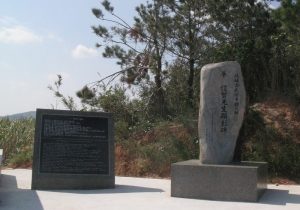 of Taira Shinken sensei (former family name Maesato | Maezato) who was born in Kume Island, and became the forefather of Ryūkyū Kobudō.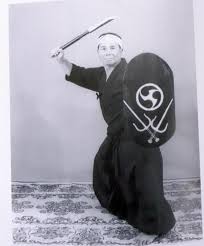
He was born as Shinken Maezato (前里 信賢, Maezato Shinken) in 1897 on Kume island in the Ryūkyū archipelago. He was the second son in a family of three boys and one girl. He was given up for adoption as a child (not an uncommon practice in old Japan). In his early life he took on his mother’s maiden name of Taira. Taira worked in the sulphur mines in Minamijima. He suffered a badly broken leg when he was trapped in a mine shaft collapse, which caused permanent damage to his leg.
In 1922, after traveling to Tokyo to find work, he was introduced to Gichin Funakoshi Sensei.
Many claim, Taira Sensei became Funakoshi Sensei’s Kobujutsu teacher, this is unlikely as Taira Sensei didn’t start Ryūkyū kobujutsu formally under Moden Yabiku Sensei until 1929. Funakoshi Sensei was already well versed in the Bo and the Sai and may have encouraged Taira Sensei in his studies.
In 1932 after studying kobujutsu for three years and karate for 10 years, he received permission from his masters to open his own dojo. Taira began to teach karate and kobujutsu in the hot spring resort town of Ikaho, Gunma Prefecture. In 1934, Taira became a student (deshi) of Kenwa Mabuni Sensei.
The kobujutsu of the Ryobukai is directly attributed to this lineage. Konishi Soke studied with Taira Sensei and taught students on his behalf. He encouraged and taught both Ryusho Sakagami Sensei and Inoue Motokatsu Sensei. Both would become senior figures in the evolution of kobujutsu on mainland Japan. In fact, Inoue Motokatsu Sensei would inherit Taira Sensei’s direct lineage and become the head of the Ryūkyū Kobudo Hozon Shinkokai in mainland Japan while in Okinawa this role would be headed by Eisuke Akamine Sensei.
Ryusho Sakagami Sensei would produce one of kobujutsu most famous students the popular and talented Fumio Demura Sensei.
Taira Sensei created the nunchaku kata taught in Ryukyu kobudo Taira no Nunchaku which is still taught by the JKRUK.
Taira Sensei is credited with composing Maezato no Tekko, a kata using metal horse stirrups. The name Maezato relates to his birth name. He continued his studies in kobudo cataloguing over forty traditional weapons kata from around Okinawa.
By 1940 Taira Sensei opened a kobudo dojo in Naha, Okinawa. He also opened dojo in Kantō and Kansai, two major districts of central Japan. In the post-war era, even in Okinawa, the number of kobudo students was much lower than the number of karate students. To revitalize Okinawan kobudo study, in 1955 he established the Ryūkyū Kobudo Hozon Shinkokai as a continuation of Moden Yabiku’s Ryukyu Kobujutsu Society.
Taira Sensei was in 1960 Shihan for the Nihon Kobudo Kenkyujo and in 1963 vice-President of the International Karate Kobudo Federation. On July 1, 1964, he was promoted to Hanshi by the Japan Kobudo Federation. He was the first president of the Ryukyu Kobudo Preservation and Promotion Society(July 1970).
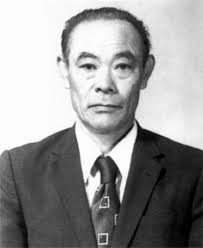
| Akamine Eisuke was born May 1, 1925 in the last years of the Taisho Era. Until his death on January 13, 1999, he lived in the Nesabu section of Tomigusuku, the small village in southern Okinawa where he was born.
In 1942, at the age of seventeen, he began the study of Yamani-Ryu bojutsu (staff art) under Higa Seichiro, Higa Raisuke, Higa Jisanburo and Akamine Yohei (no relation). From his early teachers, Akamine Sensei learned these kata; Soeshi no Kon, Sakugawa no Kon, Shirataru no Kon and Yuniga no Kon. In 1944, Akamine Sensei married his wife, Shizuko. Shortly thereafter, at age nineteen, he was drafted into the Japanese Army where he served one year in Taiwan. When he returned to Okinawa, Akamine Sensei resumed vegetable and sugar cane farming and his study of Yamani-Ryu bojutsu. |
 |
 |
In 1959, Taira Shinken was teaching Kobudo in a Goju-ryu Karate dojo in Naha, Okinawa. While there, he heard of great bojutsu teachers who lived in the Kakazu section of Tomigusuku village. To satisfy his curiosity, he went to Tomigusuku to study Yamani-ryu bojutsu with Akamine Sensei’s teachers. This was the first meeting between Taira Shinken and Akamine Sensei.
One day, Taira was asked to demonstrate Tekko (metal knuckles), Nunchaku (horse bridle) and Sai (truncheon). Akamine Sensei had never seen these weapons before. He was so impressed with Taira’s waza that he decided to become his deshi (student). As Taira’s senior student, Akamine Sensei would be in the unique position of watching him organize the various waza into a system that would eventually become Ryukyu Kobudo Hozon Shinkokai. |
| In addition to building a structured curriculum, Taira was adding a training element that would permeate all Ryukyu Kobudo waza and kata and as a result, become part of the signature of this weapons system. Higa Yuchoku was a student of Chibana Chosin and a noted teacher of “Te”, the origin of Karate. Higa and Taira Shinken were close friends.
As he continued his relentless study, Taira recognized that Kobudo, while effective, lacked the explosive power found in Te. Specifically, it lacked gamanku (hip technique). Taira’s ability to effectively demonstrate gamanku was limited by his rigid, muscular physique and a permanent ankle injury. However, he insisted on it from his students. So, he asked Higa Yuchoku to help infuse his system of Kobudo with gamanku. After Taira’s death, Akamine Sensei continued to seek Higa’s counsel on the use of gamanku. |
 |
 |
In 1959, Taira Shinken was teaching Kobudo in a Goju-ryu Karate dojo in Naha, Okinawa. While there, he heard of great bojutsu teachers who lived in the Kakazu section of Tomigusuku village. To satisfy his curiosity, he went to Tomigusuku to study Yamani-ryu bojutsu with Akamine Sensei’s teachers. This was the first meeting between Taira Shinken and Akamine Sensei.
One day, Taira was asked to demonstrate Tekko (metal knuckles), Nunchaku (horse bridle) and Sai (truncheon). Akamine Sensei had never seen these weapons before. He was so impressed with Taira’s waza that he decided to become his deshi (student). As Taira’s senior student, Akamine Sensei would be in the unique position of watching him organize the various waza into a system that would eventually become Ryukyu Kobudo Hozon Shinkokai. |
| Akamine Sensei taught waza and kata for all of the nine weapons of Ryukyu Kobudo Hozon Shinkokai:
• Bo (Staff) |
 |
 |
In addition, Akamine Sensei continued Taira’s tradition of research and with the help of his students, brought several kata back from extinction.
By all accounts, Akamine Sensei was a quiet and stern teacher whose primary focus was the development of waza. Within the Okinawan martial arts community, he was known as a teacher’s teacher … someone that teachers came to for a deeper understanding of their own techniques. With a small dojo and a focus on quality rather than quantity, Akamine Sensei intentionally kept his student roster small. He only had fourteen first generation students. |
| Akamine Sensei once said, “If I teach you kata, you will forget it tomorrow. But, if I teach you waza, you will have it for a lifetime.“ | |
 |
| Hiroshi Akamine was born into a martial arts family. Born in 1954 in Aza Kakakzu in the village of Tomigusuku, as the fourth son of Eisuke Akamine, he was destined to study the martial arts from his father, grandfather, and family associates. His father, Eisuke Akamine, was the 2nd President for the Ryukyu Kobudo Hozon Shinkokai; while his grandfather, Higa Raisuke, was a bo expert under the Yamane Ryu bo system. |
 |
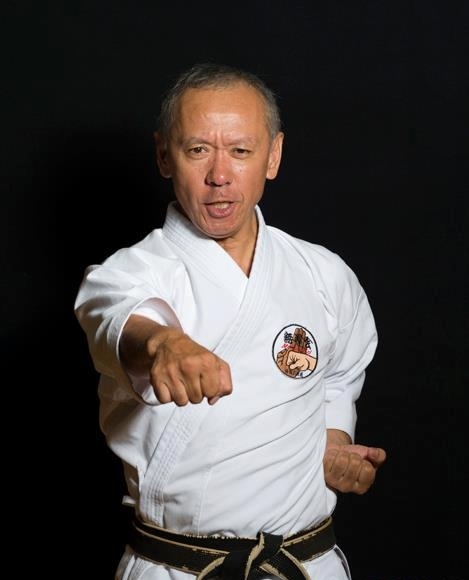 |
In 1960 Hiroshi Akamine began his karate training at the tender age of 6 under his father. In 1968, Akamine studied the art of tinbe /rochin (shield and short spear) under the weapons master, Shinken Taira; the 1st President for the Ryukyu Kobudo Hozon Shinkokai. Akamine began his training in the art of weapons from Taira at the age of seven when Taira would periodically visit his father’s dojo. In 1970, after Taira’s passing, Akamine’s father continued his Kobudo training. At around this time, the young Akamine began his karate training under the famous Shorin Ryu karatedo expert, Shijin Gushiken. |
| In 1988, Akamine received his 5th dan in Shorin Ryu Karatedo by Gushiken and received his teacher’s license in 1994. In 1997, Akamine received his 7th dan in karatedo by his father and he was also presented with the teacher’s license in Kobudo. |
 |
 |
In April 1999, Akamine’s father passed away and he became the 3rd President for the Ryukyu Kobudo Hozon Shinkokai. In July 2011, with new determination, he established the Ryukyu Kobudo Shimbukan based on the Shimbukan Dojo established by his father. At the same time, he assumed the position of President of Okinawa Shorinryu Mukenkai Association, which was established by Shijin Gushiken. Hiroshi Akamine currently is an 9th dan in both Karatedo and Kobudo. |
"If I teach you kata, you will forget it tomorrow. But, if I teach you waza, you will have it for a lifetime."
~ Eisuke Akamine ~
Weapons
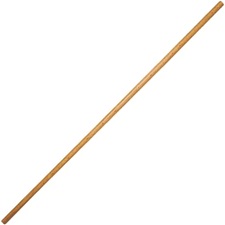
Bō (棒)
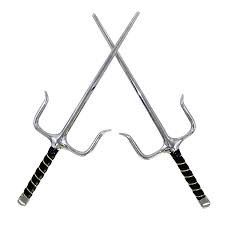
Sai (釵)
The sai is an iron weapon shaped by restraint rather than excess. Comprised of a central shaft (monouchi), two side prongs (yoku), a handle (tsuka), and pommel (tsukagashira), its design favors control over cutting. Influenced by Chinese truncheon weapons and carried by officers of the Ryūkyū Kingdom, the sai is used to block, trap, disarm, and strike. Its practice refines wrist strength, precision, and calm authority at close range.
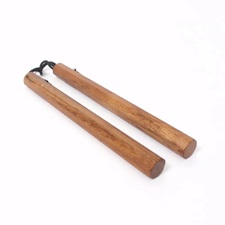
Nunchaku (ヌンチャク)
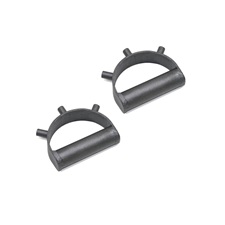
Tekko (鉄甲)
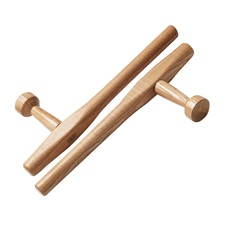
Tonfa (トンファー)
The tonfa consists of a main shaft (monouchi) and a perpendicular handle (tsuka), allowing it to be gripped or rotated along the forearm. Adapted from the handle of the millstone (ishiusu), it transforms rotation into defense and impact. Through blocking, striking, and controlled spinning, the tonfa builds forearm strength and teaches fluid transition between guard and attack.
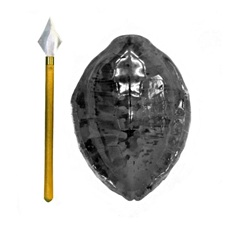
Tinbe–Rōchin (盾兵・六親)
Tinbe–rōchin unites shield and spear as a single expression of combat. The tinbe, traditionally made from turtle shell or woven materials, is held close to the body, while the rōchin is a short spear or dagger-like blade designed for quick thrusts. Influenced by Southeast Asian and Chinese weapons, this system emphasizes positioning, footwork, and coordinated movement, allowing offense to emerge from behind a stable defense.
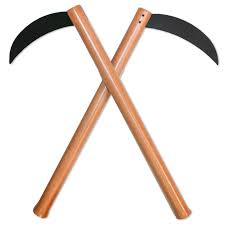
Kama (鎌)
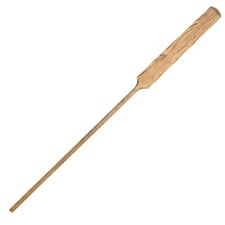
Eku (櫂)
The eku carries the weight of Okinawa’s maritime life, shaped by tide and labor. Typically longer and heavier than a standard bō, it features a broad blade (hera) and tapered handle. Adapted from the oars used by fishermen, its asymmetry produces powerful cuts, thrusts, and sweeping strikes. The eku demands rooted stance and decisive movement, reminding the practitioner that power must be supported by balance.